Porter’s book is unusual in our reading (is there something else besides “L’Enfant de Malheur”? help my tired brain) that considers what might come after life. I mentioned this quotation in my 11:00 section and Amal asked if I could post it for further reflection:
“Death is death, said Miranda, and for the dead it has no attributes” (323).
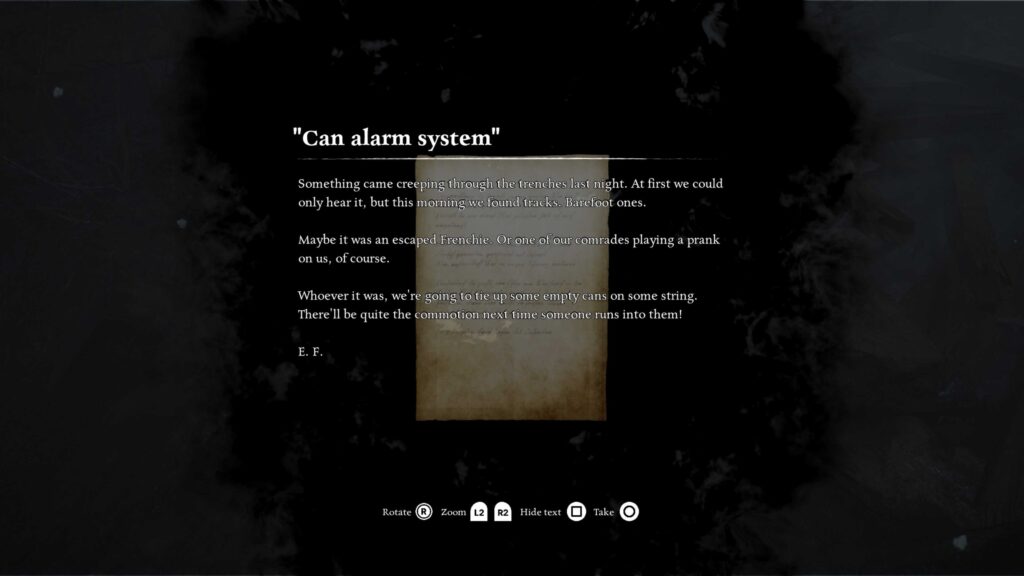
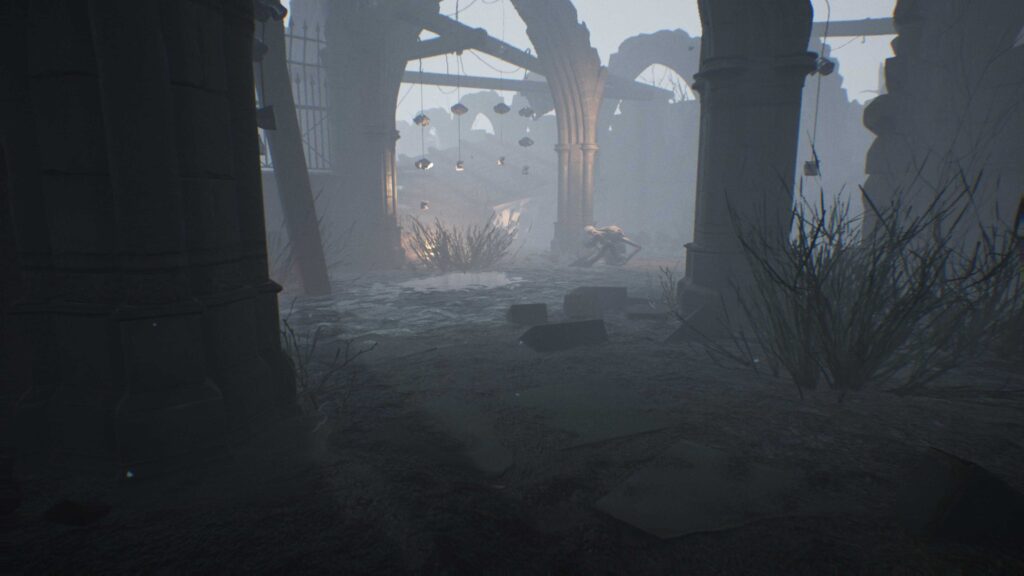
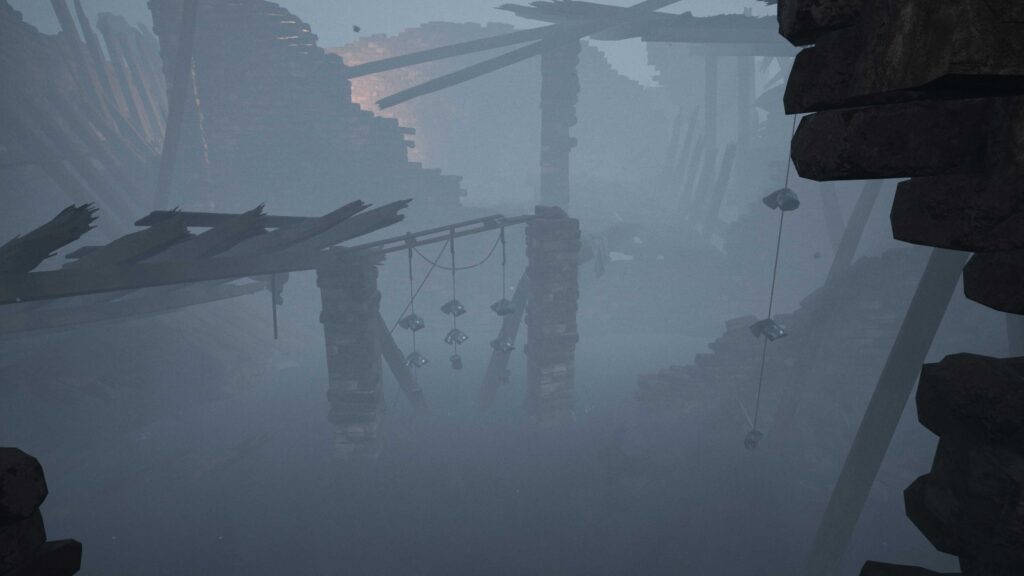
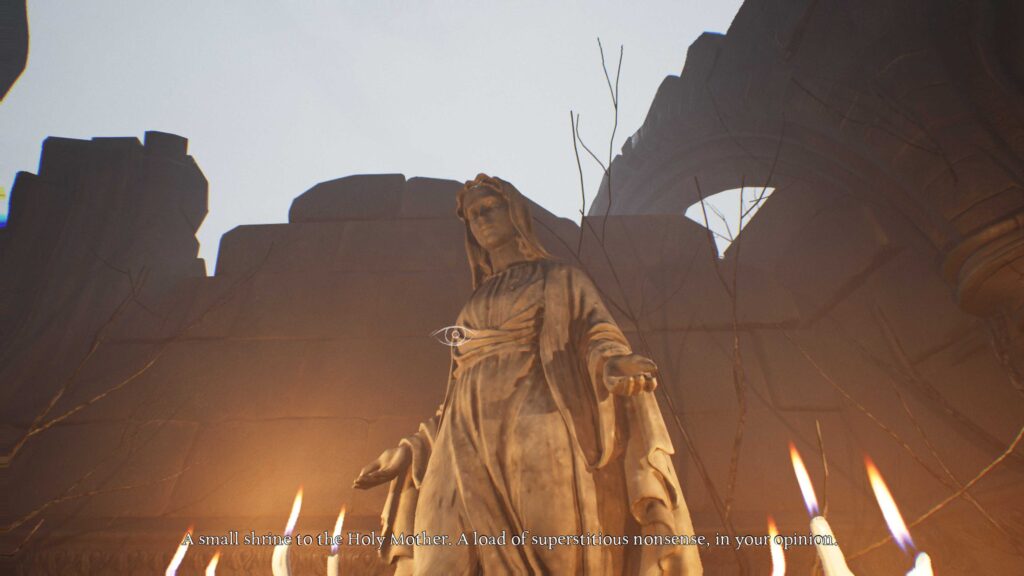
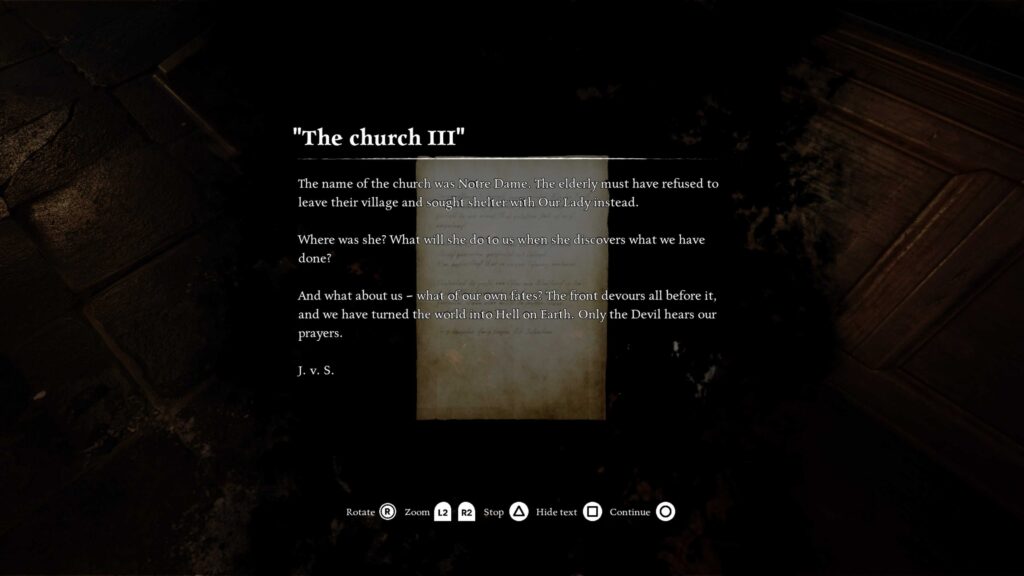
so: continuing to be a good student and play video games (after i did the reading for today! this was my reward), and i decided to continue playing Ad Infinitum and i wanted to share some of the visuals from the game because i think they’re really cool. not pictured is the ruins of a church and a cafe that was ransacked, i forgot to take pictures.
so far i really like the religious imagery in the game, i’m not far in but i think it’s cool (especially since i think the first BIG villain is called the “Mother of Sorrows”, so literally linking that back to the Mother Mary and Notre Dame stuff). i don’t know how legit the “Can Alarm System” is to real life trench warfare, but it makes for a fun mechanic to avoid the “Hunger” monsters (which btw i’m 90% sure “Hunger” is meant to represent soldiers who are reduced to the basic survival instincts, the most primal of which being hunger, they’re drawn to noise and are blind otherwise, they’re also seen eating literally anything they can get their hands on and, quite literally, blindly attack whatever moves by them). super basic read from me, i know.
but yeah cool game so far. it’s Great War related so that’s how i’m justifying my time sink, lol.
By the time the last 30 pages of the book Pale Horse, Pale Rider the reader is just exhausted. I felt as weak as Miranda finally given a good bill of health and looking to leave the hospital. What I found striking about these last pages is the profound irony and all-encompassing sense of alienation that Miranda experiences upon her recovery from the Spanish flu. She survives the illness after a full month in and out of fever dreams. When she awakes, she is told she will survive the illness, that the war in Europe has ended, and that Adam, the soldier she loves, did not survive his bout with the Spanish flu and died w. her lover, Adam, has died, leaving her with a feeling of profound grief and a jaded perspective on life and survival.
Key striking elements include:
The Ironic Ending: The novella concludes with the line, “Now there would be time for everything”. This is an ironic inversion of the hopeful biblical passage (Ecclesiastes 3). For Miranda, “everything” now only encompasses grief, suffering, and the pain of living, rather than hope or joy. The end of the war, a time for universal celebration, becomes a moment of private devastation for her.
The Loss of Hope and Innocence: Miranda’s recovery is not a joyous return to life but a return to a grim, “soiled gray” reality, in stark contrast to the beautiful, utopic visions of light and connection she experienced during her near-death hallucinations. The vibrant colors associated with Adam have given way to the “paleness” of sickness and death, symbolizing her loss of vitality and hope.
Persistent Alienation: Even after surviving her ordeal, Miranda feels fundamentally separated from the world and those around her. She feels “a flick of distrust in her joy” and the human faces around her “seemed dull and tired”. This emphasizes a core modernist theme that alienation is an inherent part of the human condition, which even love cannot fully bridge.
The Pain of Living vs. Peace of Death: Miranda’s journey in the final pages leads her to the realization that the “horror” of living a life marked by loss and emotional pain might be more challenging than the peaceful oblivion she glimpsed in her fever dreams. She returns to the conscious world but feels like a “monster” in her own body, permanently transformed and estranged by her trauma.
Emotional Detachment: Miranda finds she cannot even conjure a clear image of Adam’s face, a powerful symbol of her emotional detachment and the finality of his absence. She is forced to cope with his death and the new, empty reality that awaits her, marking a distinct “before and after” in her life
That’s it, that’s the post. Really, though, Pale Horse, Pale Rider is one of the most beautiful short stories I’ve ever read. The dream sequences especially were so vivid and even magical, they practically took my breath away. The tenderness and realness of Miranda and Adam’s relationship, too, which of course made the ending all the more heartbreaking and bittersweet.
Anyway, I’ve added a complete collection of Porter’s short stories to my “want to read” bookshelf. I need more!!
Page 307 there is an interaction between Adam and Miranda that REALLY REALLY stood out to me. Miranda makes a declaration about the war that is one of the most straightforward things I think we have read. Like all the books we have read have the same undertones and themes that say the same thing as what Miranda says on page 307 but none as direct as her. She says “The worst of the war is the fear and suspicion and the awful expression in the eyes you see……… I live in fear too, and no one should have to live in fear.” (we are gonna focus on the blue words when I compare what she said to what Adam responds with but I wanted to include the fear part of her quote because I think thats a pretty progressive and compassionate statement for the time. I think during this time with the war, the flu, everyone is struggling individually that it was a pleasant surprise to see someone who is dying from the flu recognize the pain of everyone around her. Like she is still sad and heartbroken for other people even as she struggles herself and its nice to see a character who isn’t completely centered on her own suffering ( not to say I don’t understand why other characters we have read have been solely focused on themselves because that’s valid they are going through a lot but I like this compassion and I think it speaks volumes that she said “no one should have to live in fear” instead of just talking about her self. like we need that energy)) So she’s talking about how the war inflicts emotional, psychological and physical damage to everyone, and she specifically gives more details about how unsettling eyes become after the war and how they have “pulled down the shutters over their minds and their hearts.” Notice how she says their EYES are scary not their faces. And Adam eventually responds saying “If I didn’t go, I couldn’t look myself in the face.” He says in the face not in the eyes. The phrase should be in the eyes but he says in the face. Even when I went to type the quote from the book, it automatically autocorrected to “in the eyes” because that is what the saying is and he deliberately says face. It’s a small detail but I found it incredibly important as it changes the whole interaction in my opinion. It reveals ALOT about Adam’s character. When he says “face” instead of “eyes” he’s agreeing with her and they are interlinking. He’s agreeing that war can change people and war is bad and he probably won’t be able to look himself in the eyes after it but even in knowing the truth about war (as opposed to most of our characters who before the war didn’t know the full truth) he still feels he has to go because he doesn’t think his enlightenment puts him above the rest or excuses him from suffering. And that is the moment I knew he was doomed. He’s labeled as a sacrificial lamb and on page 308 we see another foreshadow when “For just one split second she got a glimpse of Adam when he would have been older, the face of the man he would not live to be.” Anywho I know in the end page 307-308 were minor but I thought it was interesting how much foreshadowing and attention to detail revealed so much about each of their characters. There’s a lot more analysis to be done about the rest of the book but it’s super depressing so I chose to spam about pages that wouldn’t make me cry. #ripadam:(
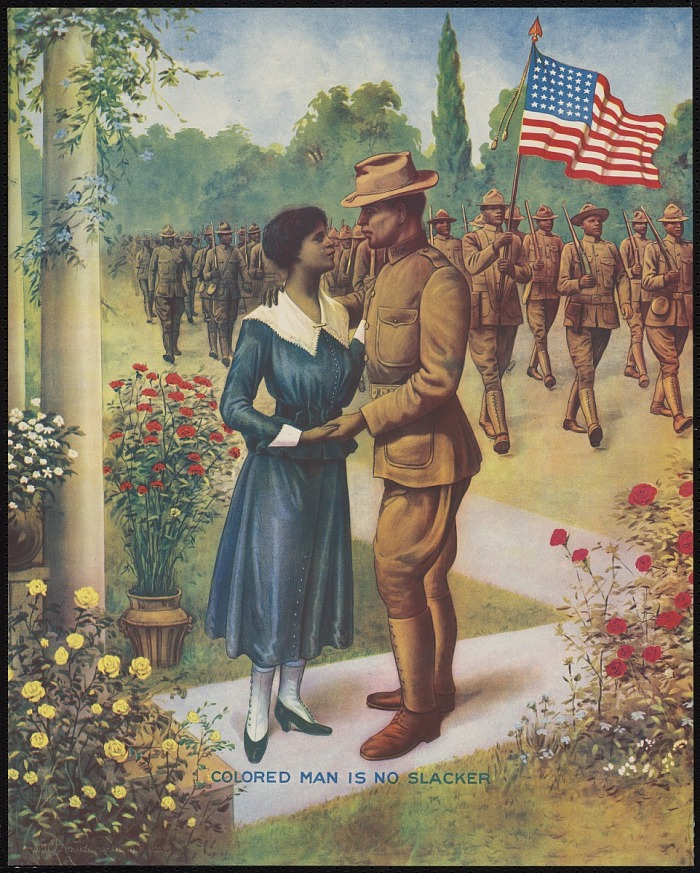
I’m surpised to admit it but I enjoyed looking at the posters in the library a lot more than I expected myself to. I think that they are all interesting since they are over a hundred years old but I think that the posters that have a unique artistic style or unusual wording are the most intriguing in comparison to the stereotypical posters with Uncle Sam and boring messages. I looked up articles to find posters that may corespond to this criteria and I came across this poster by the artist, Edward George Renesch.
This poster initially caught my eye because of all of the color and lack of any large lettering. There were three things that kept my eyes on this poster in particular. The first thing that surpised me was the fact that this poster is solely comprised of African American soldiers. I had no idea that the U.S government made posters designated for these men. I was then surpised at how concise and not only that but, how small the lettering is. It’s bluntness seems to be an anomaly from what I have seen throughout my voluntary research. It seems as if this wording isn’t meant to incite enlistments through promises of honor, excitement, or glory but solely meant to make the viewer feel pressured or guility. It’s just so straight to the point and visually small that this took me by surpise.
I also found it surprising how much detail went into the natural elements in the foreground and background. Those roses and the vine wrapping around the column have to consitute this poster as having the nicest natural artistic features of any poster from the First World War. Something else that I think is interesting is not about the poster but rather how little information I could find abut the artist. One component that I think is an indication of the lack of information is the fact that this artist does not even have a Wikipedia page.. I admitedly did not spend a large amount of time trying to find information about this man but I couldn’t even find a picture of him. When I looked him up via Google Images, there were only pictures of his artwork. This makes me curious to try find out more kind of like in the “Challenge Accepted” kind of way despite not knowing how realistically feasible that is.
On page 309, there’s a passage focused on a woman next to Adam and Miranda. What are your thoughts on her story? Why did they put a focus on her? Many of the readings we’ve covered so far convey a message about how leaders and society are forcing people into war. Could the man guilting the woman for staying sober be an allegory for the idea of shaming people during the war?
In the bottom passage on page 317, Miranda has a dream focused on Adam. The dream foreshadows Adams’ death and Miranda’s survival. Did you have thoughts on this specific dream? Could the message of this dream be that no matter what Miranda does, she cannot stop Adam from going to war or his death? Another question relating to Adam’s death: how do you feel about Adam dying from influenza? Instead of dying from battle, he dies from an illness that he most likely got from watching over Miranda. Why do you think Porter chose for Adam to die due to caring for Miranda?
On page 322, Miranda has another nightmare. What are your thoughts on this dream? What’s the purpose of why she thinks the doctor is a German Spy? Why in her sick dreams does she believe in war propaganda about the Germans?
So after reading the first assignment of Pale Horse Pale Rider and the article about the pandemic that broke out in 1918, I can’t help but realize how absolutely tragic it is that a deadly new flu swept the world and took so many lives from the generation that was already exterminated and destroyed by the war, shortly before said war was about to loosen its grip on humankind. The fact that soldiers and nurses could’ve survived the war only to come home and shortly thereafter contract the illness and die, or have to watch a loved one die, is so devastating.
Anyway, this got me thinking about what I’ve learned in my psych classes about how mental health can affect physical health and vice versa. Specifically, chronic stress is soooo bad for one’s immune system, like genuinely terrible. Clearly, everyone in the U.S. and most European countries was under severe, long-lasting stress during this war. By 1918, humankind was simply exhausted, and I think this played a major role in the successful attack of the influenza (along with the spread of germs via soldiers living in unsanitary conditions and the lack of food across nations, etc.) Not only were people depleted physically, but mentally as well. Hope for an easy victory was lost at this point, and the horrors of combat broke people down.
Through Miranda’s perspective of the home front, we see not only despair and anxiety but also attempts to deny the dark reality of war, feelings of inferiority in men who can’t fight, and a general numbness/dissociation of American society. All of these are similar to symptoms of depression. I definitely think Miranda has depression, but to me, it also seems to be a societal experience at this time. Along with the chronic stress, I say this played a huge part in the ravage of the influenza. Yes, the conditions brought upon by the war and the improper handling of it made it harder to eradicate, but the hopelessness and the low spirits and the deep, deep sadness of the world ultimately made it easier for the influenza to kill people.
Where to even start? Reading the first of three sections of the book Pale Horse, Pale Rider by Katherine Anne Porter felt like trying to walk through water; slow, hazy, limbs feeling somewhat detached. You do not “read” this book, you “feel” this book as it explores the themes of love, loss, the impact of war far away, a global contagion right in front of you, the cyclical nature of life and death. Pale Horse, Pale Rider does not provide the usual written story: a protagonist, her work, her love story or a clear understanding of what life is like in 1918 America in the throes of the Spanish Flu epidemic. This book is a fever dream, flitting from one thought to another with little connective narrative. The pages present an immersive, dream-like setting, blending the mundane reality of Miranda, a young woman journalist, starting out in life in Colorado during the First World War, falling in love with Adam, a soldier, with contracting the Spanish flu and suffering the worst of its effects, especially the delirium. Brooding over everything is the looming, apocalyptic presence of the Spanish Flu. In Mirada’s dreams, Death rides a pale horse, closely followed by Hades and the grave which is always either the main subject or riding on the edges of her consciousness. Even when awake, Miranda is confronted by the image of death and because the reader is so involved with Mirand’s delirium, you share in these fever dreams; what is real? What is imagined? What is somewhere in between?
Pale Horse, Pale Rider is a short book, but it is difficult to read. Porter uses two stylistic techniques that sweep the reader along with the delirium; “stream of consciousness” and “dream logic.” Specifically:
Stream of consciousness. This book is filled with intense symbolism, most notably the pale horse that finds its reference as death in the Christian bible. Miranda swings between a dream state and consciousness as she suffers the Spanish flu, an unsettling juxtaposition of daily life and mass death, all filtered through Miranda’s increasingly delirious, personal perspective. You can just feel the encroaching sickness and confusion rather than just reading about it. The writing flits between subjects, times, feelings; alienation from ‘normal’ life, worry, hope… the reader is trapped, what does this all mean in the middle of all this chaos? You can hear the internal monologue and plunge directly into Miranda’s mind; anxious, feverish and dark.
Dream logic. Defined, “dream logic” refers to the narrative structure and reasoning that governs the way dreams unfold, often characterized by surreal, illogical, or fragmented sequences. The perspective and realities shift without clear transitions, blending dreams, memories, and illusions into a fragmented, nonlinear experience. Pale Horse, Pale Rider begins with a dream that foreshadows the coming illness, blurring lines between fantasy and reality, showing the inner state of Miranda’s mind. Ordinary events, like daylight or conversations, are described with jarring, almost violent, figurative language. An example is how Miranda wakes up in an early morning and claims that “daylight strikes a sudden blow”, highlighting Miranda’s psychological distress and making the environment surrounding her feel threatening.
Meaning. Porter shows how sometimes humans go through difficulties of isolation and trauma. Miranda suffers depression and the only time she is comfortable is when she is unconscious. Miranda gradually recovers but discovers that Adam has died of the Spanish flu and the war has ended. The events of the First World War and the Spanish flu epidemic highlight the importance of relationship and the fragility of life. From the story, it is clear that humans always experience misery and grief in life. Miranda’s illness and life in war-time America heightens the sense of alienation. She has lost family and friends to the epidemic, and now looks for someone to care for, and care for her. When she finds Adam, she finally feels a sense of belonging; however, his death and her recovery only emphasize the tenuous hold of life and human relationships. Miranda is left with no one in her life, and she remains alienated from society. Usually, death is the tragedy in a story, but not in this case. Adam dies of Spanish flu, but Miranda recovers, which begs the question ‘why?’ She is the victim of the cruel truth of the fleeting nature of life. It is inevitable that our relationships will succumb to the power of mortality – that pale horse with a pale rider.
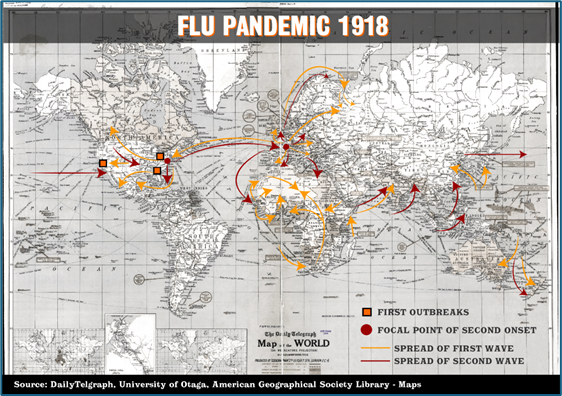
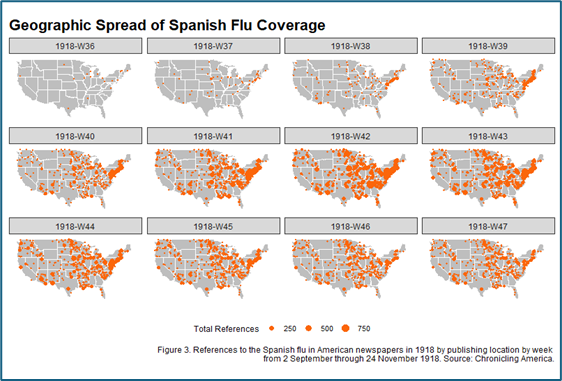
———————————- Pandemic Then and Now Map —————————————
Pandemic “Then and Now” maps. Pandemic “then and now” maps are usually drawn to record the historical outbreaks of disease or contagion, such as the Black Death during medieval period or in this case, the Spanish Flu epidemic of 1918. “Then” maps primarily serve as retrospective illustrations of disease spread. “Now” maps illustrate the pandemic graphically but also use “real-time,” interactive tools such as advanced Geographic Information Systems (GIS) and “big data” to inform immediate public health responses. The Johns Hopkins University has a good thumbnail sketch of the difference. Specifically:
Historical Pandemic Maps (“Then”). Historical maps are often static visualizations created after the fact to document the path and impact of a disease. Key here is:
Data Collection. Information was gathered through written records, reports, and ship logs, a slow process that did not allow for real-time tracking.
Purpose. The maps served an explanatory and historical documentation purpose, helping future generations understand the scale and path of an outbreak. A famous example is John Snow’s 1854 cholera map, which used hand-drawn marks to link cases to a specific water pump, a revolutionary use of mapping at the time for identifying the source of an outbreak.
Technology. Maps were physically drawn or printed, limited by the technology of the time (e.g., wood-block prints).
Focus. They often showed the movement between major population centers or regions over months or years, sometimes encoding case numbers with simple visual elements like cross marks or bars.
Modern Pandemic Maps (“Now”). Modern maps, exemplified by the recent COVID-19 pandemic, are dynamic, data-intensive tools used for immediate decision-making and public information.
Data Collection. Real-time data is collected from health systems, testing centers, and even anonymous surveillance (like location data and wastewater testing) using advanced IT and automation.
Purpose. Maps are essential for current surveillance, preparedness, and response efforts. They are used to pinpoint hotspots, manage healthcare resources, inform the public, and guide the implementation of control measures like quarantines and travel restrictions.
Technology. They utilize GIS technology, web-based tools, and data visualization platforms (dashboards) for rapid updates and analysis.
Focus. They track granular details such as daily new cases, confirmed cases, deaths, vaccination rates, and variant spread, often down to local or regional levels.