The poets Rupert Brooke, Isaac Rosenberg, Ivor Gurney, Robert Graves, David Jones, and Edmund Blunden all served as soldiers during the First World War and used their poetry as a means of personally witnessing and expressing the extreme physical and psychological limits of the experience. All of them experienced the war on the front lines and all of them were deeply affected by the horror they personally experienced. Brooke died of an illness while on his way to the Dardanelles, and as such, did not participate in trench combat in the same way as the others, but he saw what the outcomes of combat were and what the experience did to the men who returned. All of their poetry is rooted in this direct, often brutal, experience. Specifically:
First-hand experience. Unlike previous war poets, all of these authors (with the exception of Brooke, whose early death and patriotic verse predated the worst of the trench warfare) were in the front line, experiencing trench warfare and shell bombardments directly, which shaped their poetic content. All of them conveyed the graphic and realistic imagery of the trenches, gas attacks, and the constant presence of death.
Witnessing the war’s reality. Their combined voices provided a collective, personal, and often graphic, testament to the industrial scale of World War I’s tragedies and the human cost of conflict. Their works convey a range of intense emotions, including fear, anger, love, despair, and the psychological trauma (shell shock) that many endured.
Challenging romanticism. Their poetry, in varying degrees, moved away from the initial public enthusiasm and romantic ideals of war (initially shared by Brooke) to a more cynical and disillusioned portrayal, contrasting the “old virtues” of honor and glory with the grim reality of industrial slaughter.
Psychological and emotional toll. Many, including Graves and Gurney, suffered from neurasthenia (shell shock) or other psychological trauma, which deeply influenced their writing and its themes of fear, anger, and the loss of innocence.
Shaping national consciousness. Their poems have become a fundamental part of the cultural memory and conscience of the war, illuminating the hopes and disappointments of their generation.
1. In Isaac Rosenburg’s “Dead Man’s Dump” we see quite a few instances of graphic language, giving us insight into some of the horrors and scenes that soldiers saw on the battlefield. How do these graphic and gruesome scenes relate to some of the texts that we’ve read over the semester in terms of the messages that they attempt to show? Do you think any of the texts had equally or more graphic scenes?
2. In another poem by Issac Rosenburg titled “Break of Day in the trenches” there are a few different themes, almost as if it’s combining war with nature with the rat and the poppy along with the overhanging feeling of hopelessness throughout the entirety of the poem. As a result, how do these factors contribute to the poem’s message? Does this theme help or hurt the poem and its message?
3. Edmund Blunden’s “1916 seen from 1921” is a much different poem when compared to the others as it focuses on the main character actually looking back to a previous time period in remembrance and grief. Not only this, but there is an immense and overwhelming sense of grief, loss, and despair throughout the poem that simply can’t be ignored as you continue to read through it. How do the feelings of loss in this poem compare to others that we’ve read? And how do these feelings of loss reflect on the immense cost of life during the war?
Brooke titled his poem 1914, the first year of World War 1. What does using that year as a title imply about the poem and its themes? Why do you think Brooke chose to use it as the title?
The third and fourth lines of Graves’ A Dead Boche shows that he expects that the audience does not believe that “War’s Hell”, even after hearing the same from other sources. How do those lines reflect the attitude of the people who didn’t participate in the war effort?
How does Blunden’s 1916 Seen from 1921 show the feeling of displacement veterans of fighting in World War 1 had after they returned home? How is this similar to the experiences of soldiers in other stories we have read this semester?
Question 1. In one of the poems we read, “A Child’s Nightmare,” in the book Poetry of the Great War. We see the use of innocence vs violence and the trauma that it sets for a child. My question is, is this really a dream or something the child has trauma to, or is this ptsd from the experiences of the war and battle, carrying on as they grow? It doesn’t give us a direct answer on how to interpret the poem, so it made me want to question the difference between a childhood dream and a childhood reality due to trauma. There is a line that raised a question for me: “I dreamed it once again; I woke afraid.” However, the child cannot escape the fear even when not in the reality of the world around them.
Question 2. In Roseburg’s poem “Dead Man’s Dump,” there are many sensory overloads through smells and sounds. It represents what it was like there during this time. Examples such as “The sour smell of the smashed men” or “The wheels lurched over the sprawled dead.” Do you think using this descriptive language helps readers gain a clearer understanding of what heroic sacrifice looks like firsthand?
Question 3. In “First Time in” by Gurney, we see the psychological rupture and loss of who they once were as humans as they prepare to serve in the war. When hearing this line in the poem “our bodies, timid, tensed like wire,” how do we see the psychological standpoint of them entering the war and the change to their innocence?
When reading Breakfast, what stood out to me most was how detached war can feel—for the people fighting it and for those on the front lines. The story made me think about the emotional distance and numbness that often accompany conflict, even in moments that should feel profoundly human. I also found our class discussion particularly thought-provoking, especially the question of who has the “right” to write about conflict or injustice. The idea of what can be said about war by people who haven’t experienced it firsthand is a complex and important concept to explore.
I believe that the act of writing about horrors, atrocities, and war, whether from personal experience or from a place of empathy and research, plays a vital role in memorializing these events. Literature becomes a way to acknowledge suffering and to preserve the lessons that come from it. By putting these experiences into words, writers help ensure that the realities of internment, prejudice, and violence are not forgotten. Instead, they become something we can confront, learn from, and strive to prevent in the future. At the same time, authencity, accuracey, and ethos are still a matter of concern, which makes the argument much more dicey.
I mention all his to highlight Breakfast, itself. Gibson did not fight on a front, but was a Private in theh British forces, at one point during the war. His poem has themes of detachment and emotional withdrawl from Ginger’s death- which reminds me of the death of Kemmerich in AQOTWF.
What contrasts the two texts is that AQOTWF was written by someone who fought on the frontlines, but is able to note and lay claim to detachment from the world (when Paul comes home), attachment to futile (they have no barring at the front lines) and worldly things (Kemmerich’s boots). Gibson does not see the front, yet I’d argue that he does the same in his poem- betting on football teams, and going right back to warfare and trench-life after death. My analysis is that Gibson had the ability and access to the sentimate that Maria-Remarque might have had access to. I think his work in Breakfast still holds and accurate way of creating literature like his combatant counterparts, creating accuracy themeactically.
Is it “right” per se … not so sure in my mind, the jury’s still out.
The First World War provided the raw human emotional material for many of the great writers of the early 20th century. In this case, poetry is the subject and work specifically created by seven writers; Thomas Hardy, Rudyard Kipling, Laurence Binyon, Charlotte Mew, Robert Service, Wilfred Gibson, and Winifred Cannan. Each author has a deep and personal experience of the war, its effects on those who fought in it and those who were left behind on the Homefront. Of the 16 poems in this assignment, each deal with the themes of sacrifice, desperation, heroism, patriotism, hope and despair. All of the words reflect the human experience during one of history’s most catastrophic events and each writer offers a unique perspective on the enormous social changes precipitated by war. Each poem evokes deep emotional responses by exploring these enduring themes. Specifically:
· Sacrifice. Sacrifice is a predominant motif that highlights the profound implications of war on both soldiers and civilians. Rudyard Kipling, in particular, summarizes this theme by presenting the stoicism of individuals facing the brutal reality of combat. He emphasizes the idea that courage does not always lead to glory, openly critiquing romantic ideals of heroism. An example is in the poem “My Boy Jack” where a parent asks “when do you think that he’ll come back?” and the answer is “Not this tide or any tide,” but we do not hear the parent’s response to the death of the boy Jack. Thomas Hardy also addresses the sacrifice of life, focusing on how individuals often get lost in the irresistible pull of the tide of war, serving as a reminder of the personal costs of nationalistic fervor. In his poem “I Looked Up From My Writing” the stanza goes, “did you hear his frenzied tattle? It was sorrow for his son who is slain in brutish battle, though he has injured none.” Dead… and for what? This theme is poignantly echoed in Laurence Binyon’s “For the Fallen,” where the act of sacrifice transcends mere loss, elevating fallen soldiers to a state of symbolic immortality and creating a collective memory of their heroism. This poem has two memorable lines about sacrifice transcending loss “fallen in the cause of the free” and “glory that shines upon our tears”. These young men are dead, but their sacrifice is glorious.
· Despair. Despair permeates war poetry, revealing the emotional toll paid time and again by those who lived through the hell of the First World War. Charlotte Mew’s work articulates the psychological ramifications of loss and disillusionment that took over once ideals that led to war crumbled in the face of bleak realities found on the battlefields and at home. In her work “The Cenotaph” (see note below on the cenotaph) there is a line which goes “not yet will those measureless fields be green again, where only yesterday the wild sweet blood of wonderful youth was shed.” Youth, never to see the green grass of life again. The visceral descriptions in Wilfred Gibson’s verse delve into the depths of pain, showing the anguish of separation and the disturbing specter of pain. In the long-form poem “Between the Lines” we follow a soldier who is trapped ‘between the lines’ of the Germans and the British, wounded and laying for days in a bomb crater. He is gravely wounded and in the words, we see his consciousness swing between his current situation in the mud and blood of the battlefield and his bone-wearying work in the shop back home. The soldier is afraid of the shells and shrapnel that shriek overhead, the pain in his foot and leg, and being separated from the banal work of home. Deep and dreamless sleep is his only escape. The theme of desperation not only serves as a testimony to individual suffering, but also reflects a broader social response that slowly came to understand the futility of conflict.
· Heroism. Heroism, a thematic counterweight to the desperation and sacrifice described in many of these poems also emerges in many of these works. As traditional notions of heroism are scrutinized and challenged, these works redefine heroism by describing acts of humanity and resilience. Winifred
Cannan’s portrayal of ordinary people embracing their roles in the middle of chaos highlights this idea that heroism is many times just the simply act of compassion. In her work “For a Girl” the poem tells a girl to put on her best clothes and go to the street to cheer for the soldiers passing by on their way to war. It goes on to say that when the war is over, all dreams will come true, but the last line says the dreams “never can come true” because so many of those soldiers never came home. It is such a sorrowful poem, but no where do we see the words admonish the girl to be sad – it is just expected that she will bear this sorrow, silently inside her. Robert Service’s depiction of camaraderie illustrates how solidarity and collective action often exemplify true heroism far more than acts of singular valor on the battlefield. In his poem “Tri-color” two soldiers are speaking about the fields of northern Europe and the poppies that grow amongst the shocks of wheat. The poem references time spent in canteens and laughter but by the end, one of them asks to be lifted up as he is dying, because he will “win my cross” – a medal for his heroism on the battlefield. He is dying, but also reminiscing about times gone by in the company of his comrades-in-arms.
The First World War poetry of Kipling, Hardy, Binyon, Mew, Service, Gibson, and Cannan collectively articulates the intertwined themes of sacrifice, desperation, and heroism. Through their poignant reflections, these poets capture the complexity of human emotions and experiences, inviting a deep understanding of the physical and emotional scars of war – the true legacy of war. Their work not only commemorates the sacrifices made, but also serves as a stark reminder of the lasting impact of war on the human spirit.
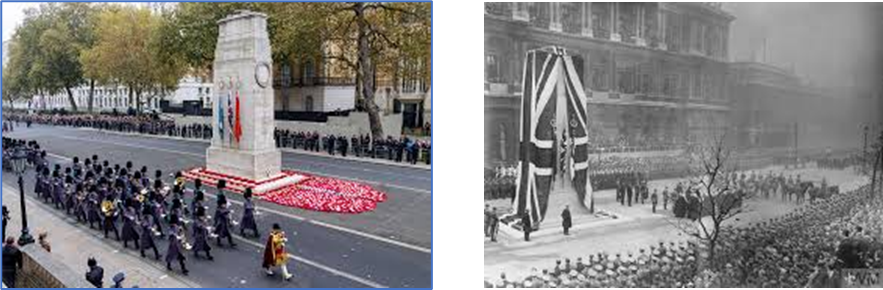
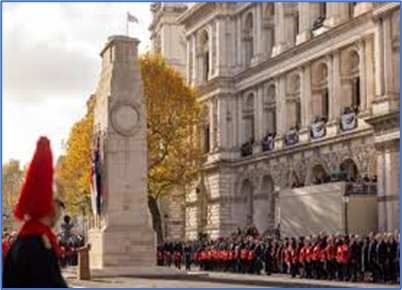
Note: A Cenotaph is a monument to someone buried elsewhere, especially commemorating people who died in war. One of the more famous cenotaphs is the one in London, UK commemorating those British and Commonwealth servicemembers who died during the First World War and are buried overseas. London’s Cenotaph was first built as a temporary wood and plaster monument in 1919 for the Peace Day Parade, then replaced by the permanent stone memorial unveiled on Armistice Day, November 11, 1920. Designed by Sir Edwin Lutyens, the Cenotaph has become the focal point for national remembrance.
Maybe this is because I’ve been sick for like a week now, but reading over this poetry (not even the combative poetry, mind you) is making me sob like a baby. I’m going to state two passages that hit me a little (very) hard:
“‘Did you hear his frenzied tattle? / It was sorrow for his son / Who is slain in brutish battle, / Though he has injured none.” (Hardy: I looked Up from My Writing. pp.10-11, lines 13-16) In this poem, Hardy tells of a father who drowns himself out of the sorrow of the loss of his son. This stanza in specific, though, just shot me right in the heart. I am not a parent, nor will I be for a hot minute, but I have witnessed my own parents grieving the loss of a child, as well as the parents of my brother’s best friend. Maybe I’m just a little extra sensitive to suicide, but this father, this poor father. We know nothing about him aside from his way of death and what Hardy assumes it to be, but OW!!!
For a Girl (Cannan). Just. All of it. It feels like something my boyfriend (who, for those of you who don’t know, is an English major and asked me out by writing poetry) would write. It made me imagine that sweet man marching off to war.
I’m going to go keep crying now. I’ve been sick for pretty much a week now, so I am just REALLY in the feels, I fear.
1. In Laurence Binyon’s “For the Fallen” and Robert Service’s “Tipperary Days”, the authors reflect on the sacrifice of children for the sake of freedom and patriotism. How do the authors feel toward the service of the younger generation and parents mourning their children? Can you see this theme in other texts from the course, and how so?
2. Charlotte Mew’s poem “The Cenotaph” mentions the grief of mothers and lovers, focusing on women and their response to the death of soldiers. Does this language have a significant affect on the reader as opposed to omitting gendered terms such as “mother” and “women”? What effects may these terms bring to this poem and how do they relate to ideas of “femininity” in the war as a whole?
3. Wilfrid Gibson’s poem “Between the Lines” mentions the influence of luck on the battlefield. We have seen the same concepts of luck and chance depicted in other works such as All Quiet and Not So Quiet. Do you see any similarities in the way luck/chance are described in these different works? How does the description of luck/chance affect the reader and their interpretation of the brutality soldiers face?
By the end of the little novel, it’s clear that Miranda will make a full recovery. Physically, that is. Mentally, she is, shall we say, not ok. She feels cheated out of a peaceful afterlife, annoyed that she has to go on living just to eventually reach the end anyways. (Similar-ish theme to “Rosa,” minus the death penalty and physician-assisted suicide.) “There was no escape,” she reflects.
What I find most interesting about her thoughts is the wizened tone she takes on. She seems to believe that she is the only human to have truly cracked the code of life and see through the facade. Her musings take on an attitude of superiority, as if she knows better than everyone else and their silly preference for life over death.
Her grief over Adam’s death, her feeling of separation from others, as well as her sense of disembodiment after a serious illness are not surprising and nothing new in the history of humanity. She may think that she will never move on, but I have hope for Miranda’s ability to overcome this trauma and live a happy, fulfilling life.
Rudyard Kipling’s ‘For All We Have and Are’ is full of patriotism and a call to fight for England. We’ve discussed from the very beginning of this course how those at home can never understand the horrors of war they send their young boys off to. How can you rationalize, if at all, this juxtaposition between what those at home believe of the war and what those in the trenches believe of it?
May, 1915 and, to a certain extent, The Cenotaph, by Charlotte Mew, both seem to have an air of hopefulness to them. When looking at the other texts we’ve studied in this course, does this hope seem disconnected from reality? To what extent is it a product of Mew’s position as a civilian, removed from the war?
Wilfrid Gibson was a man who was repeatedly turned away from enlisting due to health conditions, and when he was eventually allowed to join the Army Service Corps Motor Transport, he stayed in London carrying out packing and clerical work. What does this position– of someone wanting to enlist but unable to– contribute to his poetry?