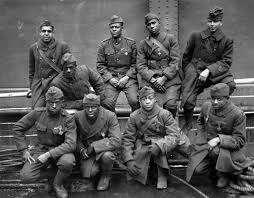
“Thirteen Black Martyrs of Houston” was a poem published in The Messenger in April 1923. It was written in reference to the execution of Black soldiers following the Camp Logan Riot in Houston during World War I. The riot began after Black soldiers were harassed and insulted with racial slurs by the Houston police. Rising tensions between the Black troops stationed there and local authorities eventually led to mutiny in the downtown area, resulting in the deaths of civilians, police, and Black soldiers.
The army held three separate court-martials, finding most of the 118 charged guilty. Nineteen Black soldiers were hanged, and sixty-three received life sentences, making it the largest murder trial in U.S. history (Haynes). Following the imprisonment and the earlier publication of the event by White author Archibald Grimké in his 1919 poem, an anonymous author expanded on the tragedy in this African-American literary magazine, revering thirteen of the executed soldiers as martyrs. The poem addresses a wide audience, appealing to those who might heed the warnings of the “White Voices” (White authority/US Army), listen to their own conscience, or reflect on the moral teachings of Christianity. While published for a broad readership, it likely spoke most directly to the Black community in the United States, affirming their dignity and condemning the injustices that occurred in Houston.
The poem carries a mournful, reverent, and accusatory tone, reflecting both grief for the soldiers’ deaths and moral outrage at the injustice they endured. The author highlights the innocence of the “black boys” and the courage and valor they displayed in service to their country, while acknowledging that they died in a world that denied them freedom and justice. I also found the imagery of the soldier’s blood powerful, as the blood spilled in the riots was red with vitality, rather than yellow with cowardice. In the first stanza, the poet questions the values and supposed ethos of the United States, a nation that “boasts” of freedom and justice, only to have those ideals abridged for Black soldiers. The author writes passionately, expressing that Lincoln’s goals were undermined as attempts at unity were suppressed and further foiled. As a reader, particularly a Black one from a military family, I find that the author reinforces the honor of a Black soldier fighting for the country, when it can result in death on both the home and foreign front, from enemies nearer than Germany.
Regarding World War I specifically, the poem and the 1917 Camp Logan Riot highlight the starkly different experiences of White and Black soldiers. While Black soldiers served courageously in the Great War, they received little respect or recognition at home; the fight to defend the ideals of “freedom and democracy” was not extended to them. I chose this poem in particular because it thematically encapsulates many of the central themes of WWI literature studied this semester: it reflects the heroism of Black soldiers, conveys grief over their execution, critiques the irony and hypocrisy of American ideals, invokes faith, and underscores the senselessness of their deaths. I particularly appreciate how this poem serves as a case study of Black American experiences during WWI and examines the aftermath in a way that few authors address, due in part to the scarcity of surviving testimony. For example, Victor Daly’s Not Only War: A Story of Two Great Conflicts reflects many similar themes through the story of Montie Jason’s service. I felt moved and enlightened by this poem, as I had not previously known about this history, and I was particularly impressed by how clearly dissenting writers highlighted injustice when it was obvious to African-Americans indicted.
Below is my reading and breakdown of a couple terms found within the text. Have a wonderful break!
Haynes, Robert V. “TSHA | Houston Riot of 1917.” Www.tshaonline.org, 1 Nov. 1995, www.tshaonline.org/handbook/entries/houston-riot-of-1917. Accessed 4 Dec. 2025.