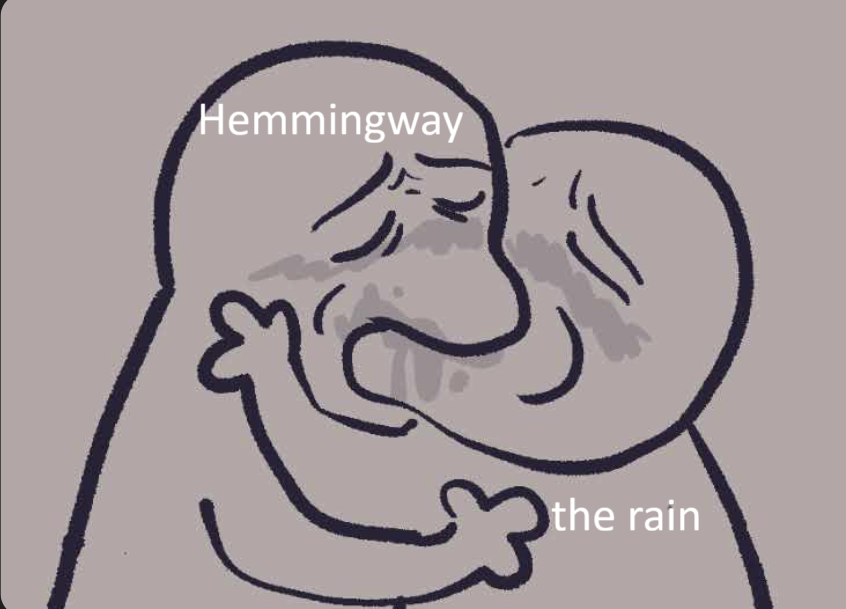
Hemingway Meme because why not
2

1.Though none of the books we have read have been autobiographies or pure true stories, they have all been based on real experiences and true events. Each novel has been a first person perspective of the war, first with Paul as a German solider in All Quiet on the Western Front, next with Nelly as a British ambulance driver in Not So Quiet, and now with Frederic as an American ambulance driver for the Italian army in A Farwell to Arms. How does the first perspective we are granted in Hemingway’s A Farewell to Arms differ from the perspectives we got from our first two books? Does the writing style make the perspective seem more detached in A Farewell to Arms? Or does it just have a different nonetheless raw angle?
2. There are quite a few descriptions of nature in A Farewell to Arms. A lot of environmental observations. The second sentence in the book is “In the bed of the river there were pebbles and boulders, dry and white in the sun, and the water was clear and swiftly moving and blue in the channels.” Chapter II even begins with a long depiction of the area’s nature and as the war progressed the lack there of. What do you think the role of nature is in A Farewell to Arms? Why is the book chock full of environmental descriptive words? Or did the presences of nature not strike you as an important theme in the book? Is it only there to “fluff it up?”
3. There was an exchange between Miss Barkley and Frederic in Chapter IV in which Miss Barkley says “What an odd thing–to be in the Italian army.” Frederic replies saying “It’s not really the army. It’s only the ambulance.” What does he mean when he says this? Is there a way to connect the sentiment behind his words to Nelly’s experience in Not So Quiet? How are Nelly and Frederic’s experiences different? How are they similar?