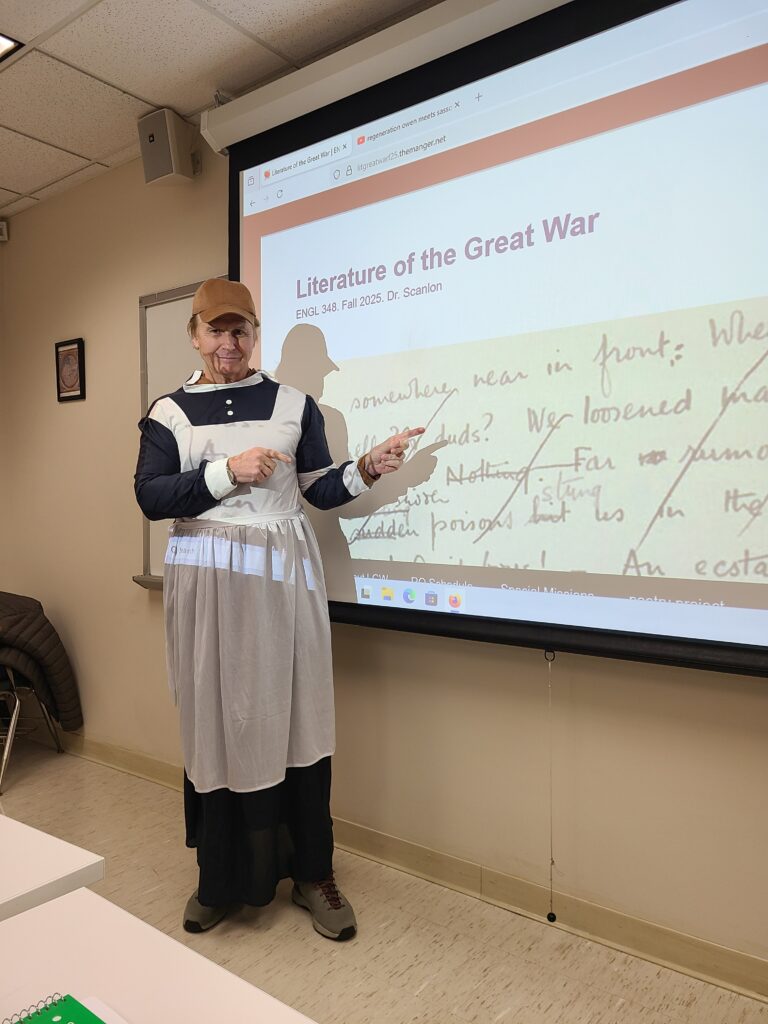
After reading the poems for class tomorrow, the one that stood out to me the most was “The Kiss,” so I wanted to offer my thoughts and my (perhaps?) reach of an analysis. I was particularly struck by Sassoon’s language when describing “Sister Steel.” He gives the weapon very feminine qualities, and at times the poem reads almost sexual. For example, he says she “glitters naked, cold and fair,” romanticizing the weapon itself. He even compares her impact on an enemy soldier to a “kiss.”
What I found interesting is that this language highlights not just the soldier’s practical relationship with his weapon, but also the subconscious ties and dependencies that form around it. There’s a sort of intimacy here: the weapon protects the soldier more reliably than any human could, yet it does so by harming and killing others. That raises a moral question: how “good” can this protection be if it requires someone else’s death, if the weapon is both a guardian and a source of death?
I think feminizing the weapon almost emphasizes how aware the soldier is of this unsettling relationship. It’s almost as if he feels seduced by the weapon’s power—drawn in by its “beauty” or reliability, yet also aware that it is ultimately lethal. In that sense, the speaker shifts some of the blame onto the weapon itself, as though it perpetuates the very system of violence he hates but must participate in to survive. It’s also significant that this weapon is imagined as female, tapping into stereotypes of women as deceptive or dangerously alluring. And I know he imagines one of the weapons as male too, but it’s interesting that Sassoon portrays that weapon as seeking praise from him (“And splits a skull to win my praise”), while Sister Steel reads as far more merciless and almost cunning, or at least that’s how she seems to me. This may be a reach, but I thought I’d share in case anyone had similar (or even entirely different) thoughts!
“The Soldier” by Rupert Brooke is a sonnet that expresses patriotic idealism, suggesting that if a soldier dies in battle in a foreign land and is buried where he fell, that place will become “English” forever because his English body lies there. The poem argues that the soldier’s body, formed by England, will enrich the land and that in death, his heart will be cleansed, and his thoughts will become part of a peaceful, eternal mind filled with happy English memories. It portrays an uplifting and romantic view of the sacrifice of a soldier for his country which is in stark contrast to the gruesome realities of war that emerged later. It is important to remember that Brooke died very early in the war and as a result, most of his work is in keeping with portraying war as “a glorious cause” where British patriotism is as high a virtue as bravery and sacrifice. Specifically:
Physical sacrifice. The speaker in the poem believes that if he dies, his body will become “a richer dust” in a foreign field. This dust is inextricably linked to England because the land has given him his very being; his body, his love for flowers, his ability to roam, and his breath.
England immortalized. By burying the soldier’s body, a piece of foreign land is transformed into a small part of England, with his English “dust” now a permanent part of it.
Spiritual and mental legacy. The second stanza suggests a transcendent transformation. His heart, purged of evil, will pulse with thoughts and memories of England; its sights, sounds, laughter with friends, and the gentleness of peace.
Patriotism and identity. The poem presents an idealistic and romantic view of patriotism where a soldier’s identity is so completely bound to England that even in death, he carries England with him and returns a part of it to the earth.
Why this poem?
Any soldier who has ever been in combat overseas has time to think about death; death in general and what will happen if death is ‘personal’. Combat is not training in your home country where it sometimes can be viewed as a game; in combat there is a very real possibility that you could die… then what? What happens to you? Today, there is a commitment that a soldier will not be left behind on a field of battle and given the improvements in miliary capabilities, soldiers have confidence that their earthly remains will be identified taken back home for burial. This was not the case in the First World War where soldiers were buried near where they fell – provided their bodies were found and properly identified. Every soldier in combat during the First World War had time to think about the terrible possibilities of death: what would be the effects of their death on the loved ones back home? Will your body be found? Where will your mortal remains end up? Will those you care about be able to find you? What will death be like? Not to be melodramatic, but in my previous career, I thought about the same things, and I took solace in the belief, like Brooke, that wherever it happened, there would be a little piece of America to be found if I fell.
About the Poet Rupert Brooke.
Rupert Brooke joined the Royal Navy after the outbreak of the First World War in August 1914, and was commissioned into the Royal Naval Volunteer Reserve as a temporary lieutenant shortly after his 27th birthday. Brooke was assigned to the Royal Naval Division, an infantry division consisting of Royal Navy/Royal Marine personnel not needed at sea, and took part in the Siege of Antwerp in October 1914.
Brooke sailed with the British Mediterranean Expeditionary Force on February 28, 1915 but developed severe gastroenteritis while stationed in Egypt. Not long afterwards, Brooke and his unit embarked on a ship bound for the landings at Gallipoli, Türkiye and while under way, contracted streptococcal sepsis from a mosquito bite which became infected. Surgeons aboard a French hospital ship anchored off the island Skyros, in the Aegean Sea, carried out two operations to drain the abscess, but he died of septicemia on April 23, 1915. Brooke had just turned 27 at the time of his death. As the expeditionary force had orders to depart immediately, Brooke was buried in an olive grove on Skyros. Friends of Brooke assisted at his hastily organized funeral and his final resting place remains on the island along with a monument erected by those same friends.
Note 1. Sonnet. A sonnet is a fourteen-line poem written in iambic pentameter, employing one of several rhyme schemes, and adhering to a tightly structured thematic organization. The name is taken from the Italian sonetto, which means “a little sound or song.”
Note 2. Iambic Pentameter. Iambic pentameter is a poetic rhythm with ten syllables per line, arranged in five pairs called “iambs.” Each iamb consists of one unstressed syllable followed by one stressed syllable (da-DUM). This creates a ten-syllable line with five beats, similar to the rhythm of natural human speech.
1. Throughout the poem “The Kiss” by Sassoon, alliteration is thoroughly incorporated into each stanza (1. Sister Steel, 2. Splits a Skull, 3. He sets his heel, etc). What does this repetition of sounds add to this specific piece? Does it have to do more with the rhythm of the poem or the speaker’s voice?
2. The poem “The Poet as Hero” is driven by a primarily loathing/hateful tone, almost in a way that is different to other poems we’ve read regarding the war. How does this tone differ from other works? What does it suggest about self-identity and emotion that other poems haven’t?
3. How does Sassoon use the concept of social hypocrisy in the poem “Base Details?” How might this idea connect to previous literature we’ve read not in our poetry section?
I chose Wilfred Owen’s “Anthem for Doomed Youth” because it captures, in one concise and devastating space, everything I’ve come to feel about the First World War after this semester. Owen’s poem aligns with my own pacifist ideals in a way that felt both validating and unsettling. I find it hard to express my feelings without getting overly emotional or angry but this poem seems to put into words exactly how I feel about the war and the meaningless deaths while also subtracting the rage I personally struggle letting go of. It also talks about death in the war from such a raw vantage point that its metaphors hardly feel like metaphors at all. When he compares the dying soldiers to “cattle,” the line doesn’t read as a poetic flourish, it feels like realism, like the only language blunt enough to match the dehumanizing machinery of industrial warfare.
After reading All Quiet on the Western Front, Not So Quiet, A Farewell to Arms, Not Only War, The Forbidden Zone, and the rest of our Great War poems, I realized Owen’s voice functions almost as a chorus for all of them. It’s a blunt refusal to let readers turn away or forget the truth about what soldiers truly faced. The poem was meaningful to me now because it mirrors the emotional arc I went through in this class. Each text dismantled the myths I still subconsciously carried about WWI, and Owen’s poem felt like the natural endpoint of that process. Choosing it to close the semester was appropriate for me because it gathers all the themes we’ve studied (disillusionment, grief, protest, and the human cost of nationalism) and expresses them with clarity. Ending with this poem allowed me to acknowledge how deeply the course has reshaped my thinking about war and the responsibility of remembering it honestly. Regardless of the broad thematic representations found in this poem, it is primarily about the end. It is about death. So in my mind, the poem serves as a symbol for not only everything we have learned in this course but also how the course is ending. As the blinds close on our time together as a class, I think this poem is a beautiful conclusion
I discovered Wilfred Owen over the summer in a tiny Penguin Classics collection, about fifty pages long, containing some of his most well-known war poems. As someone who historically has struggled with understanding and interpreting poetry, I never struggled with Owen. Something about his writing just clicks in my head and my heart. He is the first poet who’s work has ever made me cry.
As for my poem selection, “A Terre” is a French phrase that means “on the ground” or “to earth,” and is told from the perspective of a dying soldier in a hospital, directed at an unknown listener, likely a very young one, but it is easy as the reader to put yourself in the place of the addressee. The soldier laments about what he would do if he were physically sound again, even the most menial of jobs.
The beauty of this poem to me is the returning to the natural world, the images of wind and lilac shoots and the sun, and how once returned to the earth, even war will no longer disturb him. There is so much humanity in this soldier–he is angry, sarcastic, gentle, yearning, tired all in turn. But even though he is going to die, there is this thread of peace in being reunited to the earth. It’s a sort of closure which I found almost fitting as the semester comes to a close as well.
Poppy field video credits: Atomic Shrimp on Youtube: Slow TV–Poppy Field
Ezra back again with another film I’ve seen that’s relevant to this unit.
Benediction, a 2022 film, follows the life of Siegfried Sassoon. It’s meant to be a “biographical romantic drama film”, and, if I recall correctly, doesn’t focus a ton on the war. But the war is definitely a looming presence. The reason it’s relevant to this unit is, well, obviously it’s a biography of Sassoon, but also it covers Sassoon’s meeting of Wilfred Owen in the hospital facility and their time in that facility.
(It also stars Jack Lowden as Sassoon which, if you saw my post on The Passing Bells, you shall know is a benefit to me because, hey, I think he’s pretty cute.)
Again, disclaimer that I’ve only seen this once, when it first came out (also I was on a plane at the time), so if you don’t like it or if it’s actually horrible, don’t come for me.
“Anthem for Doomed Youth” has been one of my favorite poems, possibly ever, since I first read it in middle school. I even read it aloud for a poetry competition in ninth grade (I didn’t do well in the competition, but that’s unrelated to the poem itself). So then, a couple years later, I was browsing Britbox (a streaming service specifically for some British shows) at my great-aunt’s house and I found a miniseries called ‘The Passing Bells.’ This immediately struck me as interesting, of course, as did my recognition of one of the main character’s actor, Jack Lowden, who also acted in Dunkirk. (That one is about the British evacuation of Dunkirk Beach in World War Two, so not quite on theme for this class, but I would highly recommend it still. Anyways.) I watched the miniseries, and enjoyed it well enough, and then mostly put it out of my mind until I re-read “Anthem for Doomed Youth” for this class.
So, I have a show recommendation! It’s called ‘The Passing Bells’, put out in 2014 by the BCC as part of their WWI centenary season. It follows two teenage boys, one English and one German, as they enlist and fight in the First World War. I liked how it showed them both as individuals first and soldiers second, with their own wants and needs and lives at home, which sort of reminds me of how Paul from All Quiet… was talking about how the enemy soldiers were people too, just like them. Fair warning, I can’t guarantee it’s amazing, because I only watched it the once and haven’t been able to find it again, but it certainly wasn’t bad.
I find it incredibly interesting that Wilfred Owen’s short biography before his poems makes it a point to emphasize that he was a very religious man. But I thought his first poem was honestly anything but promoting religion. In my reading of “Anthem for Doomed Youth,” I found it to be a criticism towards religion and the Homefront in general for responding to eminent death with bells or prayers. The line that stuck out to me the most was “No mockeries for them now; no prayers nor bells.” He quite clearly (in my read at least) equates prayers and bells to mockery. Owen says the soldiers “die as cattle” painting the picture that these people were just sent to the slaughter house by going to war. Maybe he feels the Homefront is what is making a mockery of religion and he thinks there is a different way to practice? I am not sure. But still the poem felt like more of a criticism towards religion then a praise. Especially the end where he mentions the blinds and how a new day is like the blinds coming down (symbolizing new found ignorance with each new day people seem to forget about the tragedies of war or the deaths). Just interesting.