Maddie Timmons’ Post on W.B. Yeats (“An Irish Airman Foresees His Death”)

Canva/Audio Link: https://www.canva.com/design/DAG6rg8YEVI/UMmVg7rW-Cfj7LLjaQm49w/edit?utm_content=DAG6rg8YEVI&utm_campaign=designshare&utm_medium=link2&utm_source=sharebutton

Reflection:

I have not seen another war poem communicate detachment the way this one does, and I focused on conveying that feeling through the tone of my reading. What intrigued me most is how calmly the speaker talks about death, as if he has already accepted it, and how he describes rising “to the clouds above” with a strange sense of peace. While this kind of mentality is common in a lot of the literature we have read, something just felt different about it. The poem also brings attention to something often ignored in discussions of war. Soldiers did not usually hate their enemies, since both sides were made up of young men pushed into fighting strangers. Yeats goes further in this analysis by showing that the people soldiers were told they were protecting were also strangers to them, which removes any comforting idea of fighting out of love or loyalty for their homelands. That lack of personal connection on either side emphasizes the futility of the war and exposes how hollow war propaganda really is. The poem’s quiet and emotionally distant tone truly resonated with me. It stuck out to me as a reader and has many layers of sadness and emotion to it that are difficult to deal with.

Maddie Timmons’ Reading Questions for December 4th (Owen cont. & Sassoon)

1. Throughout the poem “The Kiss” by Sassoon, alliteration is thoroughly incorporated into each stanza (1. Sister Steel, 2. Splits a Skull, 3. He sets his heel, etc). What does this repetition of sounds add to this specific piece? Does it have to do more with the rhythm of the poem or the speaker’s voice?

2. The poem “The Poet as Hero” is driven by a primarily loathing/hateful tone, almost in a way that is different to other poems we’ve read regarding the war. How does this tone differ from other works? What does it suggest about self-identity and emotion that other poems haven’t?

3. How does Sassoon use the concept of social hypocrisy in the poem “Base Details?” How might this idea connect to previous literature we’ve read not in our poetry section?

Remembrance Day

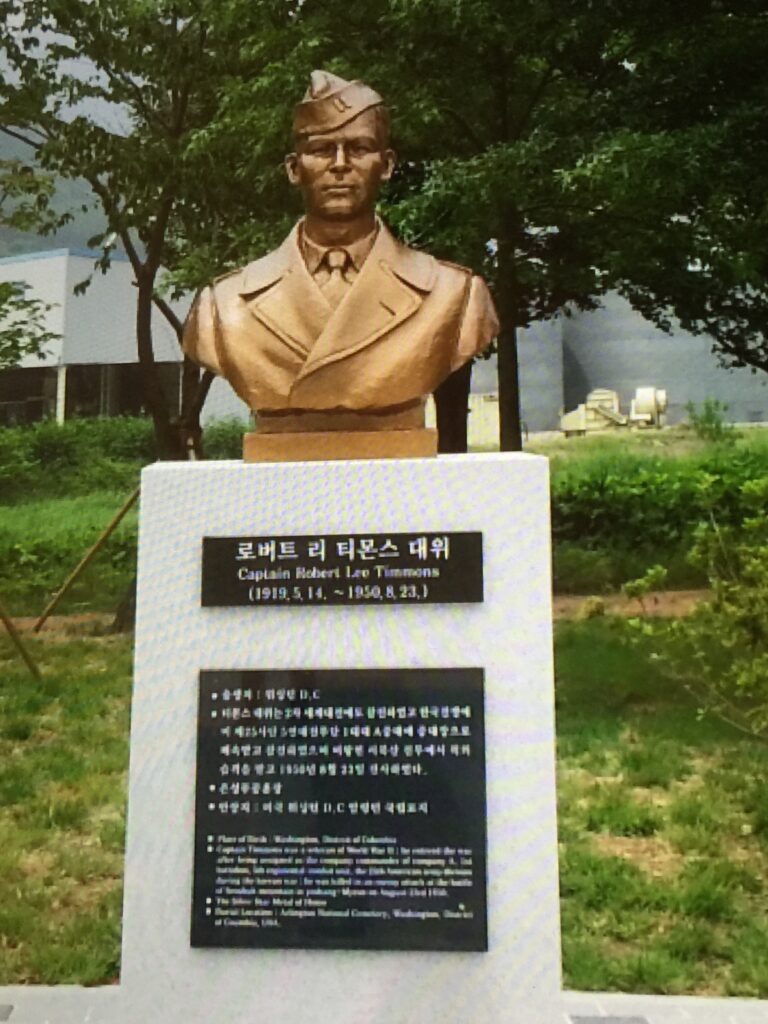
My great grandpa served in World War II and died in action in Chindong-ni, South Korea. He was a silver star general and commanded both a battalion and combat team. A statue was built in South Korea honoring him and the other men who died in battle. My dad sent me a translation in English of the inscription on the monument (Mt. Sobuk monument)

“The battle that beat North Korea soldiers so that U.N. Forces could counterattack took place here (Chong Won, Gyeongsong Province South Korea) in August, 1950. It was so fierce that Captain Timmons and a hundred soldiers died in this battle. Richard Timmons, who is Captain Timmons’ son, Korean army and citizens in this area built this monument for honoring them in November, 1995. This was designated as a memorial monument for honoring those who sacrificed for freedom of a foreign country in November, 2013.”

(The statue is from the United Nations cemetery in Pusan, South Korea. The monument was constructed on the mountain top where he and other soldiers passed)

I know our class is about WW1/The Great War, but Remembrance Day has made me reflect on what we’ve discussed in this class and connecting it to my own’s family’s history. I obviously didn’t know my great grandfather as a man, but thinking of the literature we’ve read so far, it’s raised some questions from me. His parents lived through The Great War, and he was born just a year after it ended. I wonder what his childhood was like? I wonder if he experienced the same kind of emotions and maddening thoughts that we’ve seen in so much of what we’ve read. After reading All’s Quiet, Not So Quiet, A Farewell To Arms, The Forbidden Zone, etc, I feel almost more connected to him in a way. I feel more reflective about what him, my grandfather, and my dad (all army generals), all have had to go through and experience (even though these experiences differ).

Anyways now I’m just kind of rambling, I hope this is kind of interesting.

Rosa

Wow, this story was a particularly difficult one to read. I think what mainly upset me while reading this was the surgeon’s insistence on healing “Rosa,” simply so he could be court-martialed and killed on the army’s terms. It made me start to wonder about the general perspectives of surgeons serving in the war during this time. Was this common for surgeons to be in support of this? I’m sure after seeing so many war-torn soldiers, maybe some grew emotionally detached. However, regardless of how emotionally numb you are, to make an effort to save a life just to let it be lost once more is extremely cruel. What made me more sad was that our narrator’s efforts to argue against it just seemed futile. Also, while I understand the animalistic references/descriptions to soldiers in a lot of these stories, I really have started to hate this rhetoric. It’s just so dehumanizing, and yes, I am aware that it’s intentional. It just makes me sad that these soldiers have been quite literally stripped of everything up to even the characteristics that make them human.

Not So Quiet – Final Chapter

This isn’t really going to be an academic post, but I just wanted to write out my emotions about the final chapter of Not So Quiet. Wow. My jaw hurt at the end of this chapter because my mouth was left gaping open for so long. So much tragedy occurred in such a short span of time. I knew this was coming, we all knew this book wasn’t going to have a brighter ending than our last read. But damn. First, we read that Roy got terribly injured and is now both blind and an amputee. Next, we have to sit and read through two insufferable and rage provoking letters from both Nellie’s mother and Mrs. Evans-Mawnington about how wonderful it is that Roy is now a decorated hero. After the previous numb and sad chapters we’ve read since Nellie returned to the war effort, this really was just the icing on the cake of sadness and despair. What made it worse is Nellie’s lack of a reaction to it. She has been beaten so bloody by the war that she literally has no emotion left to give. I felt exhausted for her. Roy’s letter was a total stab in the heart as well. If all that wasn’t enough, we end the chapter with an intense air raid and all of the women she’s spent the past several months with “lying dead or dying” (70). I finished this book with a pit in my stomach. We really do see how both Nellie and Paul are destroyed by the war in different ways.