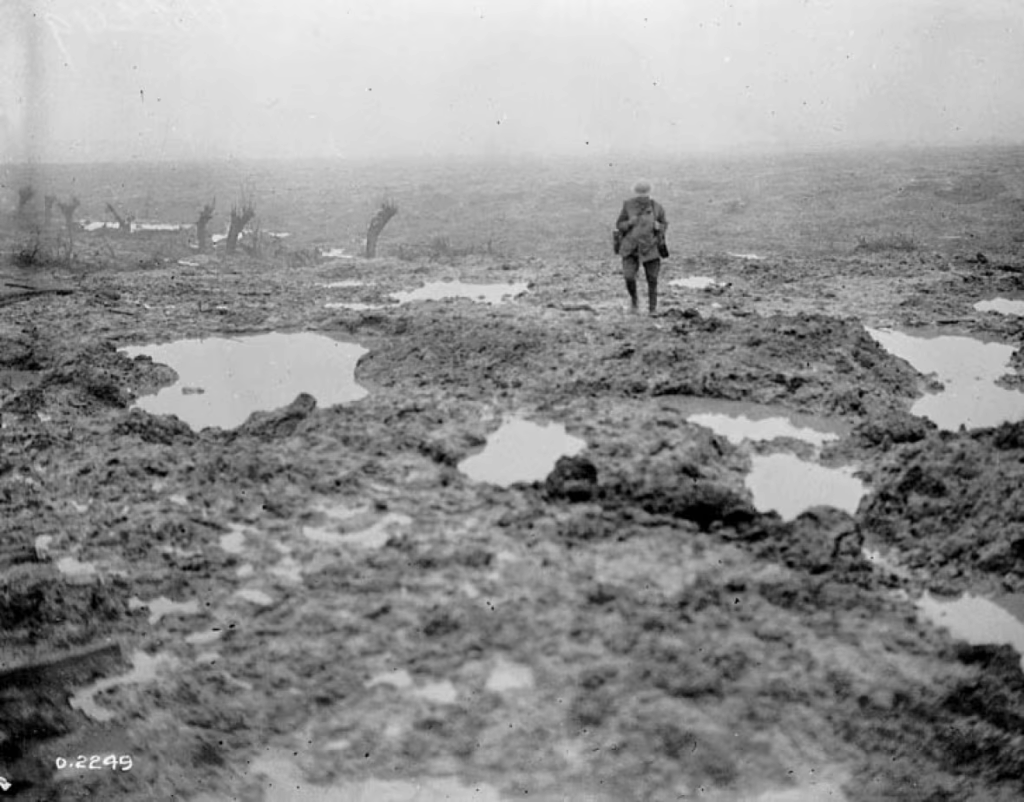
I chose Wilfred Owen’s poem “Mental Cases” because it forces me to confront the psychological devastation of war in a way that feels immediately unsettling. Owen does not allow the reader to look away. He shows how soldiers carried the war inside them long after the fighting ended. The poem mattered to me now because I kept thinking about how impossible it must have been for anyone to truly “survive” an experience that reshaped their minds. Reading it at the end of the semester felt appropriate because many of our course materials asked us to examine the human cost of violence, trauma, and the war systems that rotted men from the inside out. This poem felt like a clear reflection of those themes. I paired it with an image of an empty No Man’s Land because that abandoned and ruined landscape mirrors the inner emptiness Owen describes. It becomes a visual version of the mental void the soldiers lived with.
Author Archives: Marshall
Mud in The Forbidden Zone
Immediately upon reading the first chapter of The Forbidden Zone, I could not help but notice the repetition of “mud.” In her first passage, “Belgium,” Borden emphasizes that war has reduced a country, a culture, the citizens, and their soldiers to a state of mud. The usual protection of Mother Earth has been compromised, and instead of holding up the country of Belgium, instead of nourishing its citizens, the earth has begun to swallow its cities and towns, leaving but a few villages and a wounded terrain. The mud is wet and dense, oozing from beneath the earth’s surface, almost like blood.
This image of mud operates as both a literal and symbolic representation of war’s consuming power. It erases the boundaries between land and body, soldier and soil, life and death. Borden’s repeated emphasis on mud suggests not only physical contamination, but also moral contamination. The once-fertile ground of Belgium has been transformed into a graveyard that absorbs everything, including buildings and humanity itself. Mud becomes a visual metaphor for wartime. The soldiers, indistinguishable from the mud they fight in, embody the dehumanizing force of the trenches. Borden’s recurring use of this imagery blurs the line between nature and man, showing that war has contaminated even the earth on which the soldiers fight.

Marshall’s review of The Burying Party
Marshall’s Reading Questions for September 9th
Question 1:
As the events of All Quiet on the Western Front unfold, we are faced with the sad reality that many-a-soldier was injured beyond repair during ‘The Great War.’ However, it is only when Paul and Albert are shot in their respective legs, that we truly encounter the effects that permanent disability have on a previously, able-bodied soldier. How does the text’s language frame war wounds—as sacrifice, loss, or transformation?
Question 2:
In chapter 9, Paul confronts the realization that he is watching a man actively die, and by his own hands. In what ways does Paul’s direct encounter with the dying soldier differ from the distant, impersonal killing he has experienced in battle?
Question 3:
The end of the novel is met with what seems to be a domino effect of death among the remaining soldiers in Paul’s immediate company, including his own. What purpose does the abruptness of the ending and the rapid sequence of deaths serve in the author’s narrative?