Hannah’s Poetry Reflection on Wilfred Owen’s “Dulce Et Decorum Est”

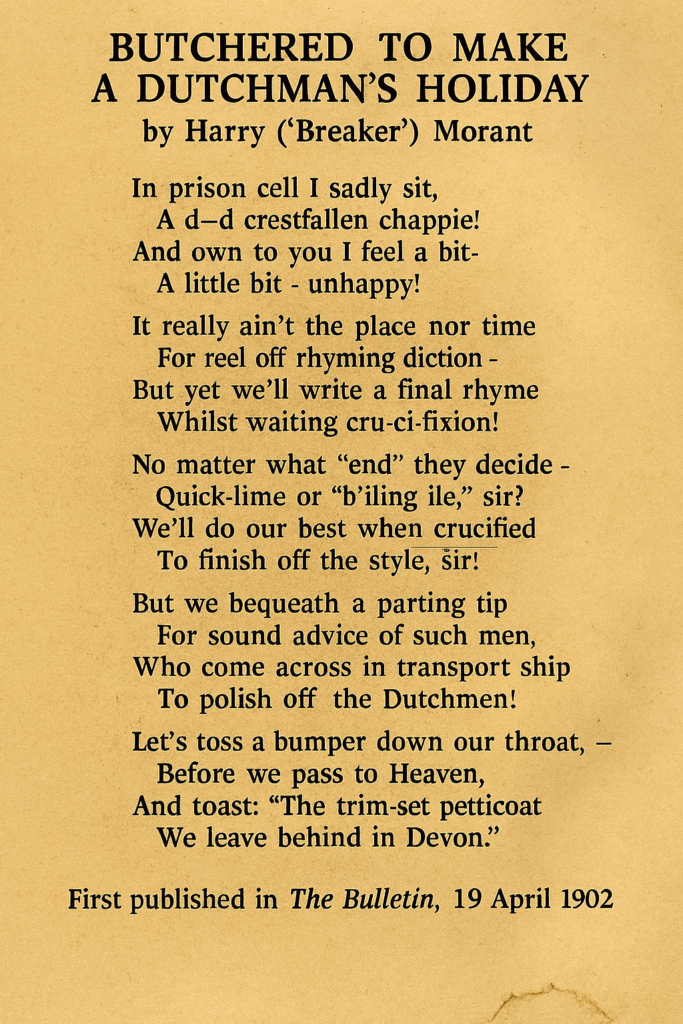
I first read this poem during a WWI poetry unit in the eleventh grade, and I genuinely haven’t stopped thinking about it since. The last lines, more than anything, have stuck with me for the last five years: “The old Lie: Dulce et decorum est / Pro patria mori.” We read several WWI poems during that unit, as well as All Quiet on the Western Front, but it is this poem in particular that has haunted me ever since. Reading it again now, after having read five books, one novella, eight short stories, and seventy poems about WWI this past semester, it has begun to take on a new meaning. When I read the poem again, I thought of Nellie driving her ambulance all night every night, of Paul teaching the young recruit how to live on the Front, of Mary Borden trying to save as many lives as she could even when the men came in with hemorrhaged lungs from the terrible gas. I knew from the very beginning of the semester that, for a poetry project, I was going to choose Owen’s “Dulce Et Decorum Est,” and I hope my interpretation doesn’t disappoint. Enjoy!

Thoughts on Siegfried Sassoon

The most striking aspects of Siegfried Sassoon’s poetry are its brutally honest depiction of trench warfare and its biting, satirical tone aimed at the politicians and generals who promoted the war as a just and patriotic cause. He uses vivid, unflinching depictions of trench warfare and the physical, mental and spiritual suffering of soldiers to break the jingoistic and sentimental myths of glory surrounding the First World War. Sassoon writes with personal and emotional intensity; he was a soldier in France who fought and was wounded, decorated for his bravery, and later hospitalized with “shell shock.” His work carries a powerful, personal authority as he turns his own war experiences into poetry that is often described as unsettling and unforgettable. Specifically:

· Unflinching and graphic Realism. Sassoon’s poetry is famous for its raw, vivid, and often gruesome imagery of the front lines, detailing “mangled limbs, filth, cowardice and suicide”. He sought to convey the ugly truths of the trenches to an audience previously lulled by patriotic propaganda.

· Angry and accusatory tone. His works are often characterized by a direct, furious condemnation of those he held responsible for prolonging the war; incompetent generals, self-serving politicians, and complacent civilians. This “scornful, harsh, and discontented” voice was a deliberate departure from traditional poetic decorum.

· Ironic juxtaposition. Sassoon frequently used sharp irony to highlight the absurdity and hypocrisy of the conflict. For example, in “The General,” a cheery commanding officer is shown to be responsible for the deaths of the very men he smiled at just the day before. In the poem “They” a bishop’s platitudes about a “just cause” and how “change” will come to the men who fought in it are juxtaposed with the horrific injuries the soldiers sustain. Yes, the men were all “changed”; some were missing limbs, some could never sleep peacefully again, some were blinded by poison gas. Sassoon wrote of the disillusionment of soldiers and his poetry captures the sense of weariness and disillusionment felt by all who were fighting and dying in a war they saw as pointless.

· Abrupt endings. Many of Sassoon’s poems employ final lines that deliver a sudden, powerful, and often cynical face-punch, leaving the reader with a shocking realization of the war’s horror and the home front’s ignorance.

· Moral outrage and protest. Sassoon’s poetry (along with Wilfred Owen) was a direct form of anti-war protest. In his famous poem from 1917, “Soldier’s Declaration”, Sassoon felt a duty to “drive away the old romantic notions surrounding warfare” and challenge the “callous complacence” of the non-combatant public back home.

In Sassoon’s work the reader comes to understand the very real, firsthand, harrowing experience as a decorated soldier (Sassoon was nicknamed “Mad Jack” for his bravery). Along with this, reading the deliberate, artful command of satire and graphic realism that taken together produces a potent anti-war testament. His work, alongside that of his friend Wilfred Owen, fundamentally shaped the modern understanding of the First World War as a senseless waste of life.

Thoughts on Wilfred Owen

After reading the 19 poems of this assignment, all by Wilfred Owen, I am exhausted. What is most striking about his poetry is the unflinching, graphic realism and profound moral outrage at the horrors of the First World War. Owen’s writing is direct counter-point to the traditional, romanticized notions of war and patriotism prevalent at the time. Specifically:

· Visceral imagery. Owen’s poetry is vivid, sensory descriptions of the front-line experience, designed to shock the reader into a new awareness of war’s brutality. His writing creates in the readers mind such vivid imagery; soldiers “bent double, like old beggars under sacks” or blood “gargling from the froth-corrupted lungs.” The scenes he writes forces the reader to confront the physical and psychological suffering of the soldiers.

· The “pity of war.” Owen explicitly stated “my subject is War, and the pity of War. The Poetry is in the pity”. This deep sense of compassion for his fellow soldiers, regardless of nationality, is a central, striking theme that emphasizes a shared humanity amidst the chaos.

· Anti-war sentiment. Owen’s writing serves as a powerful anti-war manifesto, notably in “Dulce et Decorum Est,” which explicitly refutes the “old Lie” that “it is sweet and fitting to die for one’s country” (in Latin: Dulce et decorum est pro patria mori). He condemned the jingoistic speeches and writing of the time as pure propaganda and pilloried the ignorance of those at home who encouraged young men to enlist.

· Innovative poetic techniques. Owen employed innovative stylistic choices, such as pararhyme (or half-rhyme) and variations in meter, which create an auditory and rhythmic sense of unease, tension, and disruption, mirroring the fragmented, unsettling experience of life in the trenches. He adapted traditional forms, like the sonnet, to serve his modern, brutal subject matter. A fan of Keats in his early years, he used the “lusciousness” of rhyme and meter in a way that was jarring, calling more attention to the blood and horror he wrote about so unsparingly.

· Authenticity and moral witness. Owen was an Officer in the British Army who did not shield himself from seeing all that war brought to his men; the fear, the blood, the gore, the sudden end to a young life, the hopelessness about it all. As a soldier-poet who experienced “shell shock” firsthand, his poetry carries the weight of a direct, honest testimony. This authenticity distinguishes his work; he said himself that every poem about the war be “a matter of experience” and there is no doubt that he witnessed every word he ever wrote.

Owen was killed by an artillery blast one week before the First World War ended. Although he saw only a few of his poems published in his lifetime, after the war an anthology was published, the purpose of which was to bear truthful witness to atrocity and to chronicle the horror rather than a means to buttress morale and feed patriotism so prevalent back home during his service in France. His work reflects a profound awareness of shared humanity, emphasizing fellowship among soldiers, regardless of their nationalities. His unique style, marked by abruptness and colloquial language, broke from traditional poetic forms, influencing later poets and shaping the discourse around war literature. Of his work, the poem “Disabled” is the most striking. In it, Owen speaks to the ideas of loss, sacrifice and trauma (physical, emotional and spiritual). The soldier in the poem realizes he has lost his identity as well as his limbs.

Hannah’s Reading Questions for December 2

  1. Owen’s introductory biography talks about how he was a religious man and a pacifist (152). How does “Anthem for the Doomed Youth” reflect with a pacifist reading of the poem, or reflect on the war as a whole?
  2. How do the final lines of “Dulce Et Decorum Est” compare to our other protaganists’ opinions/discussions about the futility of war?
  3. How do you interpret the title of the poem “Apologia pro Poemate Meo” (Apology for My Poem)?

The Battle of Belleau Wood, Random thoughts

While writing Essay 3, I was reminded of the lines about Belleau Wood, and I asked my history major fiancé about it. I was told that the U.S. Marines fought for about a month in Belleau Wood, despite the other Allied Forces telling them to retreat, and it was an incredibly bloody battle for the amount of forces involved because the Marines just kept charging. A German soldier wrote that the Americans were incredibly reckless (I read this as “Americans don’t have a self-protection instinct and might be the stupidest people I’ve ever seen”). They did eventually win, after throwing wave after wave of men at the Germans. WWI insanity at its peak.

Quotes that became Marine legend:
“Retreat, hell! We just got here.”
“Come on, you sons of bitches! Do you want to live forever?”
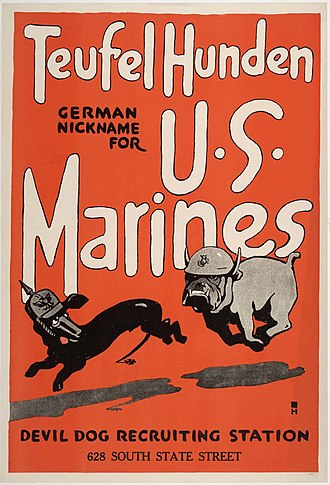
This is also the battle where the Marines supposedly got the name “Devil Dogs” from the Germans. This is disputed and believed to have been an American invention—either of the soldiers or a reporter—but the name stuck. (Personally it’s a great name, because they keep charging and holding on like bulldogs despite it being an obviously bad idea.)

This is a recruiting poster using the Devil Dog name to convince men to join.

Noah’s Reading Questions for December 2nd

I was initially planning on having each question focus on a different one of Owen’s poems, but somehow I ended up with a ton of different questions all for “Exposure,” so I decided to focus exclusively on that piece. I hope you find this deep dive into this one poem thought-provoking!

  1. Owen’s poem “Exposure” is notable for its repetition of the ending line “but nothing happens” in almost all of its stanzas. This line stands in contrast to what many would expect from a poem about WWI, since, instead of being under constant fire from the enemy, the soldiers in Owen’s poem spend far more time suffering from the anguish of waiting for the shellings to inevitably start again and from the freezing temperatures. Did you feel that Owen’s use of repetition was effective at luring you into a false sense of security that nothing would happen, or did you feel that it continually built up a sense of anticipatory dread that was never quite resolved?
  2. Once the last lines of each stanza finally did change, did you find yourself lost or caught off guard by the unclear and questioning nature of these stanzas? Do you believe that these stanzas depict hallucinations from hypothermia, or did you have a different reading of them? If you did read these stanzas as hallucinatory, how do they compare to the influenza-induced hallucinations present in Pale Horse, Pale Rider? How do the three stanzas with different concluding lines contribute to the poem’s overall themes of dread and the juxtaposition of the monotony of everyday life in war and the constant mental anguish of the soldiers fighting in it?
  3. How does nature act as an antagonistic, personified force in this poem? What do you make of the fact that the freezing temperatures are presented as a more immediate threat than the enemy soldiers? How does this portrayal of nature contrast to other pieces such as “May, 1915” by Charlotte Mew or any other pieces we have read?

“Disabled” by Wilfred Owen and Other Thoughts on Disability

I have been fascinated by the portrayals of disability throughout the class, so I found the sudden and stark acknowledgment of disability in Owen’s “Disabled” to be particularly poignant when considering other mentions of disability throughout the literature. The title itself is evocative–neither conjuring images of blown apart men, nor attempting to dampen the impact of what disability means; it simply acknowledges the reality for the man the speaker traces the story of.

Particularly in Not So Quiet, Nellie speaks about the desire for “whole” men, dismissing the men disabled or by war to the same state of otherness that she feels as a nurse. She denies them their sexuality and gender as men (arguably as a trauma response, but, hey, ableism is still ableism). Owen’s speaker talks of the man’s past loves, how alive and youthful he used to be, and contrasts them now with his disability, and, indeed, age, though his age is never given and likely not all that old. He speaks of women’s waists and hands, allowing us to see a glimpse into the humanity of a now infantilized, both impossibly old and impossibly young man, who is not without continual desire for closeness and intimacy. In the last stanza, in a strange, prophetic turn, the speaker begins to trace the future of this disabled man, seeing the continual pity and loss of humanity that will overtake him, as Nellie sees it, but doubly describing the pain of seeing women’s eyes gloss over him to favor other men. In a description not dissimilar to the opening stanza, he begs for someone to put him to bed in a way that is both desiring intimacy and acknowledging the child-like, sexless role he has been condemned to as a disabled man.

I feel that, in the literature we have read, sexuality in relation to disability is never touched on except to say that survivors of war are undesirable. And though this poem traces a similar thought of infantilization and disability, it places the disabled man at the forefront.

To the Prussians of England & Not So Quiet

Hi everyone, I just wanted to share a quick comparison between one of our poems and a different text from earlier in the semester 🙂 While reading To the Prussians of England by Gurney, what struck me most was the poem’s confrontational directness. The title already stages this tension—addressed to the “Prussians of England” rather than merely describing them—while the poem’s movement between the accusatory “you” and the collective “us” and “we” aligns the speaker with the soldiers at the front and exposes the hypocrisy of those who glorify the war from afar. This rhetorical pressure immediately reminded me of the tonal force Nellie uses in Not So Quiet when she condemns her mother and Mrs. Evans-Mawnington, women who embody the home-front ideologies that demand sacrifice without understanding its cost. Both Gurney and Nellie deploy direct address as a deliberate counter to the sanitized language of wartime patriotism; they transform private anger into public accusation. I feel that their bluntness collapses the supposedly “comfortable” distance that many non-combatant works—or simply the era’s propaganda—depend on.

Lexi’s & Olivia’s Poetry Reflection on Siegfried Sassoon’s “Christ and the Soldier”

What first caught our attention was the title of the poem: “Christ and the Soldier.” Because there are two speakers, it’s also a perfect poem to be performed as a duet. By using two narrators, it helps the audience to hear the different voices present in the poem. We just celebrated the Solemnity of Our Lord Jesus Christ, King of the Universe, which encourages us to focus our attention and effort on what really matters in this life: following the Lord’s will and His plan for our lives, even through the hardships we encounter in life. We thought this poem was an appropriate choice to finish the class because the end of the semester coincides with the Advent season, which is penitential in nature and calls us to properly prepare ourselves for the joy of the Nativity. 

In looking at interpretations of the poem online, we found that it’s meant to communicate the hollowness and impracticality of the Christian message in the face of the horrors of war. This, we think, completely misses the point of Christ’s Crucifixion and our ability to unite ourselves to Jesus and grow closer to Him in our sufferings. 

Instead of interpreting the ending as Jesus abandoning the soldier, we instead see His lack of response to mean that Jesus has died. And, as we all know the end of that story, this is great news for all of humanity, including the suffering soldier. The soldier may be greatly disillusioned with the war, but he is not alone in his pain and, through Christ’s sacrifice, now has the opportunity to be freed from sin and death.

We have both experienced moments of profound fear and loneliness, moments when God’s presence was not made explicitly clear as it had been at other times. Yet, during these low moments, we both knew that Christ was there, bearing His cross just as we bore ours, and working in our hearts to help us to not despair but to instead find strength and comfort in Him. For us, this poem is not about God being absent or ignoring us during our low moments, but instead about the soldier unfortunately giving into despair. Christ does not promise His followers exemption from this life’s pains, only that He won’t leave us in those times; our faith should not be dependent on feelings or grand gestures.