THOUGHTS
What strikes me most about the first five chapters of “All Quiet on the Western Front” is that the characters are not really developed in the classic sense of a novel. We do not know much about the small group of soldiers who come together from the same school and join a few others in a single unit. We know names; such a Paul Bäumer, the narrator in the book, some of his school friends such as Tjaden and Muller, the other soldiers they join like Katczinsky, the cobbler, the peat digger, Westhus and the farmer, Detering. What is developed is a detailed description of the war, which in the first five chapters is the subject more than the men who fight in it. In chapters 1 and 2, the work is divided between food arriving at the front and the death of a fellow soldier. There are details as to the fat in the stew, the number of cigarettes, but little talk of how it affects the people in the story. In the death of the fellow soldier, we know his name, but the details are about the loss of his pocket watch, his equipment that those who will remain covet, and the treatment of wounded soldiers in the aid station where the scene takes place. Another example is in chapter 4, where the main thing we learn about Katczynski is that no matter where he is, he is able to find food, and a great amount of detail tells us how and when he finds what the unit needs. We know “Kat”, as he is called, is married and has children, we know he is a cobbler, but beyond that, it is only his abilities in war that are developed.
This reading assignment of the first five chapters centers on the conduct of war, such as the use of poison gas that is described; “gas creeps over the ground and sinks into the hollows like a big, soft jellyfish as it floats int our shell-hole and lolls there obscenely”. One can almost feel the dirt clods and the wooden splinters whiz past while reading about the bombardment in chapter 5. But the actual characters are simply given lines that see them reacting to the events around them.
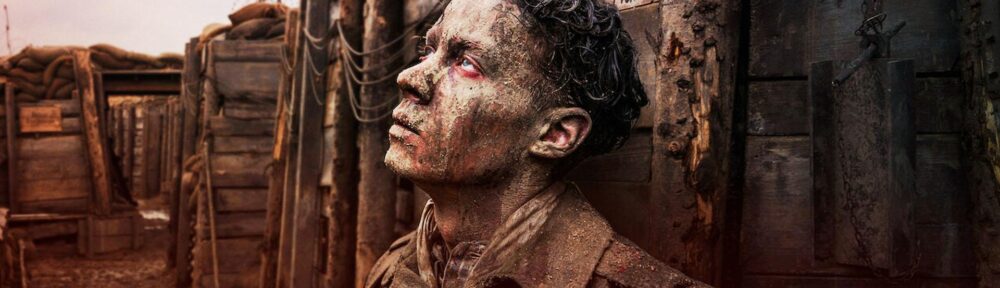
After 70 pages, the reader is bludgeoned by the account of what war has become and you join the characters in understanding the devastating effect this horror has on them. War is not heroic or patriotic, as Bäumer’s school master had taught. War is blood and death, pain and sorrow, unshakable comradery of those who live through it, and the daily absurdities that lead the book’s characters to surrender any innocence they had at the start. Everyone in uniform feels betrayed by the older generation, including the parents, that spurred them on to volunteer for the war. In the end, without knowing much about the men in this unit, we watch each of them being psychologically destroyed by what they endure.
In my earlier posting, I stated that ‘historians tell you what happened and why but it is the writers who tell you what it means’. Reading the first five chapters makes you lose your breath. The horror.
This novel is categorized as fiction, but it is based on Remarque’s own experiences in the German army during WWI. Everything that happens in the book, every horrifying story he tells, is a reflection of something Remarque saw with his own eyes.
Considering the quote you reference in your last paragraph, “historians tell you what happened and why but it is the writers who tell you what it means,” I think that Remarque’s use of the 1st person is a particularly strong storytelling device. Remarque is telling the story in 1st person present tense, and so the reader is placed on the front alongside Baumer, living it right alongside him. Remarque tells the story with a realness rooted in his own experiences, until the reader may forget that the book they are reading is actually fiction and that it’s Baumer’s story, not Remarque’s. Remarque didn’t need a historian to tell him what had happened, he just needed to find a way to tell the world, in his own voice, what it had meant.
I personally think that the “lack” of character development in this book speaks to the lack of development the young soldiers have in their lives. The physical details such as the fat in the stew are the most important things in the world to those soldiers. Their environment doesn’t lend itself to personal details because it reduces each man to someone who survives and fights. The narrator’s focus on physical things is for his own survival. If he thought in depth about what it meant to lose Kemmerich, he might not be able to continue. If all he thinks about are Kemmerich’s boots, he can carry on. We know all that there is to know about the characters at this point in time; they are as developed as the war allows them to be.
This excerpt: “The war has ruined us for everything.” He is right. We are not youth any longer. We don’t want to take the world by storm. We are fleeing. We fly from ourselves. From our life. We were eighteen and had begun to love life and the world; and we had to shoot it to pieces. The first bomb, the first explosion, burst in our hearts. We are cut off from activity, from striving, from progress. We believe in such things no longer, we believe in the war.
Just my quick thoughts because I do often think about how the youth are always “sacrificed” in times of war and how that just transcends from how society seems to treat these boys in particular as an extension of the state, and an extension of the nation, therefore expendable for the cause…of course. It is indeed horrific.